
This year, in preparation for Christmas, I decided to make Florentines – popular special-occasion biscuits that combine nuts and glacé or candied fruit. I wanted to try something new to share with my family and friends this Christmas.
I hadn’t made Florentines before.
For years, I had read (and passed over) a recipe for “Easy Florentines” in The Australian Women’s Weekly Cookbook (1970). The recipe combines sultanas, crushed cornflakes, raw peanuts, glacé cherries and condensed milk to form the biscuit dough, with melted dark chocolate spread over the base of the cooked biscuits when cool.
If you search the internet, you’ll find many similar recipes and countless images of so-called “Easy Florentines”. Clearly, these biscuits are very popular.
However, I rejected this recipe (yet again). After all, I wanted to try something more challenging – something out of the ordinary. A biscuit with a wow factor!
I remembered that there is a recipe for Florentines (Florentiner) in a little book of Austrian biscuit recipes my son gave me as a gift in 2005. It’s from this book, Best of Kekse: Die besten Keksrezepte aus Österreich, that I sourced the recipes for Brotlaibchen and Vanillekipferl, which I‘ve shared previously on this site.
Unlike the recipe for “Easy Florentines”, the recipe for Florentiner combines butter, raw sugar, plain flour, whipped cream, almond flakes, mixed peel and glacé cherries as the biscuit dough. The only similarity is the chocolate coating on the bottom (flat side) of the biscuit.
After painstakingly translating the recipe from German to English, I made a batch of Florentiner. The resulting biscuits were thin, crisp and very sweet. They tasted fine, but they didn’t look at all like the Florentines in the photograph!

I looked further afield. I searched Trove, an Australian online library database owned by the National Library of Australia. There I found the following most unusual recipe for Florentines. It dates from 1909. The recipe combines puff pastry, raspberry or apricot jam, meringue and almond flakes.
This old-fashioned recipe intrigued me, so I tried it too. I even made my own puff pastry (as housewives a century ago would have done) – another first for me! To make the puff pastry, I used this recipe (which I can highly recommend). The resulting Florentines were delicate, chewy and super-sweet little pastries. Their texture and flavour reminded me of almond croissants.

Finally, I decided to try a recipe for Florentines I found in my 1970s Sunbeam Deluxe Automatic Mixmaster Mixer Instruction and Recipe Book. You may recall my story The life and times of my faithful Sunbeam Mixmaster, which I posted on my blog earlier this year. I’ve had this recipe book since 1974 and it’s been well used! However, I had never tried the recipe for Florentines (pictured).

This recipe is unlike any other recipe for Florentines I have come across. It combines the whites of eggs, whole eggs, caster sugar, grated lemon rind, vanilla essence, spices, flour, mixed peel and crushed almonds as the biscuit mixture, with melted chocolate spread over the base of the cooked biscuits when cool.

Truly, the biscuits I produced were a total surprise – both in appearance and taste. They did not look at all like any of the illustrations of Florentines I have seen in recipe books or on the internet. But to the palate – they were irresistible!
The first time I used this recipe, the resulting biscuits were relatively small and somewhat irregular in shape. So, for my second attempt, I used a dessertspoonful of the mixture (instead of a teaspoonful) to form each biscuit. In addition, I used 70 mm diameter edible baking wafers (German Back Oblaten) to help me produce larger, circular-shaped biscuits. I purchased the baking wafers online, from The German Shop Down Under.


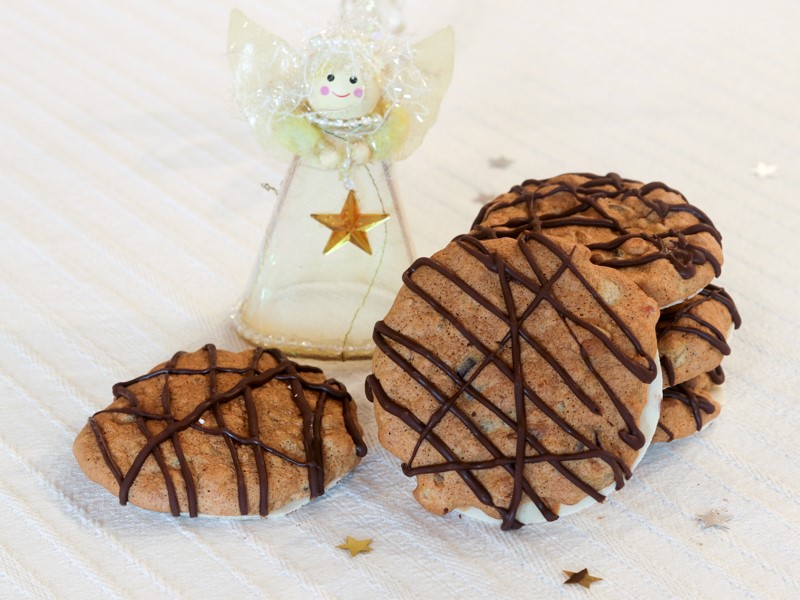
For my third trial of the recipe, I used a lightly greased and floured muffin tray. At the bottom of each “well” I placed a 50 mm diameter edible baking wafer prior to adding a dessertspoonful of the biscuit mixture. Using this method I produced molded well-formed circular biscuits.


These delightful Florentines are soft and chewy in texture, and delicately sweet and spicy to the tastebuds. They remind me of Lebkuchen, traditional German Christmas fare: sweet, spicy and chewy molded cake-like biscuits.
Without doubt, I had discovered (and tested) an extraordinary recipe for Florentines – one with the wow factor I was looking for.
Perhaps you could try the recipe yourself this Christmas.
FLORENTINES
Ingredients

Method
- Separate eggs and beat the four egg whites until stiff.
- Add sugar gradually and beat until dissolved.
- Mix the two egg yolks evenly though the meringue.
- Add lemon rind and vanilla.
- Fold in sifted spices and flour, then peel, cherries and almonds.
- Drop heaped teaspoonsful of the mixture onto greased (or papered) biscuit trays, allowing room for spreading. Flatten the dough a little and try to keep a circular shape. Alternatively, use a muffin tray. Place a 50 mm baking wafer at the bottom of each lightly greased and floured “well”. Drop dessertspoonsful of the mixture into each “well”, tapping the dough slightly to even it out.
- Bake in a moderate oven (180 degrees Celsius or, if fan forced, 160 degrees Celsius) 10 to 12 minutes.
- Allow biscuits to cool slightly before removing them from the trays. Place the biscuits on a rack to cool completely before decorating them with chocolate.
- Melt the chocolate over a steam bath or in the microwave (10 seconds at a time until melted). Add the coconut oil and stir well. Using a knife or spatula, cover the flat side (bottom) of each biscuit with chocolate and place upside down on a rack while the chocolate hardens. In the case of biscuits with a wafer base, drizzle the chocolate in a zig-zag fashion over the top of the biscuits; do not cover the bottom of these biscuits with chocolate.
Adapted from “Florentines”, Sunbeam Deluxe Automatic Mixmaster Mixer: Instruction and Recipe Book, 1974, p. 21.


